From the Seattle Times: 700,000 at Seahawks parade? Doesn’t add up, experts say.
It’s a lighthearted article, but it touches on the methodology of crowd estimation and uses some basic math to show that the number of parade attendees was less than the official estimate of 700,000.
How did readers respond to this dollop of evidence-based analysis? There were several themes, as exemplified by the following online quotes. (My interpretations are in brackets.)
(1) Semians: “Quit trying to overanalyze everything and simply live in the moment.” [We shouldn’t care about this information.]
(2) picklesp: “It sure as heck felt like 700,000 from ground level.” [This information doesn’t match my personal experience.]
(3) Peterkirk: “These guys are just trying to rain on our parade for whatever reason, and well tough, it didn’t rain on the parade on Wednesday and your diatribe (reporting?) isn’t going to make it rain today.” [This information doesn’t make me feel good, so I’ll ignore it.]
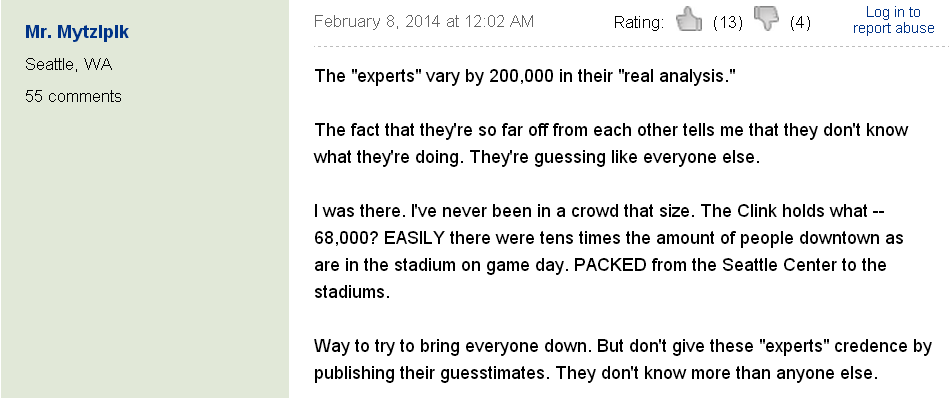
(4) Mr. Mytzlplk: “The ‘experts’ vary by 200,000 in their ‘real analysis.’ The fact that they’re so far off from each other tells me that they don’t know what they’re doing.” [Experts disagree about the details, so their analyses are worthless.]
(5) picklesp: “Experts get paid to pontificate.” [Experts have their own biases and agendas — which is true.]
(6) gloryhound: “I’m also skeptical of these two ‘experts” qualifications.” [The “experts” aren’t really experts.]
The above excerpts are from some of readers’ HIGHEST-rated comments. Here are two of the LOWEST-rated ones:
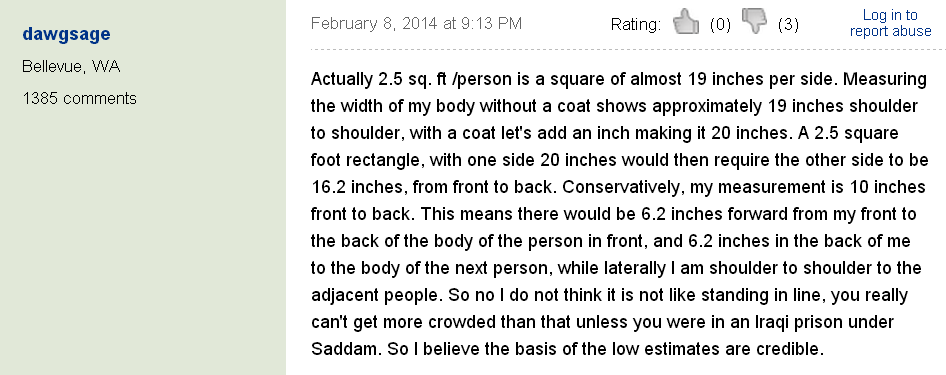
[from dawgsage:]
Actually 2.5 sq. ft /person is a square of almost 19 inches per side. Measuring the width of my body without a coat shows approximately 19 inches shoulder to shoulder, with a coat let’s add an inch making it 20 inches. A 2.5 square foot rectangle, with one side 20 inches would then require the other side to be 16.2 inches, from front to back. Conservatively, my measurement is 10 inches front to back. This means there would be 6.2 inches forward from my front to the back of the body of the person in front, and 6.2 inches in the back of me to the body of the next person, while laterally I am shoulder to shoulder to the adjacent people. So no I do not think it is not like standing in line, you really can’t get more crowded than that unless you were in an Iraqi prison under Saddam. So I believe the basis of the low estimates are credible.
[from CO Dawg:]
Rather than just say “well I don’t believe you!” to the experts, just do this simple experiment: put on a winter jacket (remember, it was cold that day) and stand against the wall with your arms against your side, then have someone mark the wall with chalk at your elbows. Measure that width. Then turn sideways and mark again the two widest points (belly and bottom for me, your points may vary). Measure that width.
Now, grab a calculator and multiply your personal width by personal depth. That is the square footage of space you occupy if you were standing in a crowd elbow to elbow belly to back and back to belly, like at a rock concert, and represents a good indication of the maximum crowd density at the parade.
When i did this with a sweatshirt on i came up with 2.1 feet wide and 1.25 feet deep, for 2.65 square feet, a little above the minimum cited. However, if i put on a winter jacket it adds an inch to all four sides so the measurements jump up to 2.25 by 1.42 feet, or 3.2 square feet. Adding just one more inch to each measurement increases my footprint to 3.8 square feet, and adding 3 inches increases it to 4.7 square feet. I wont presume anything about your personal space requirements, but when someone is 3 inches away from me, i still feel pretty crowded. I can thus conclude that the experts have presented a reasonable range for each person’s footprint
I have no means to measure the overall footprint of the crowd along the route, but had they asked me to do crowd estimates i would have employed the same methodology they use (measurements from an aerial photo), and probably would have come up with numbers similar to their’s. I would have multiplied the overall crowd foot print by an average space per person of 3.5 square feet (generally splitting the difference between my numbers), added 15% to account for people standing outside the footprint or watching from offices, and likely come up with a forecast of somewhere between 350-400k. Which is still a heck of a crowd.
And for those of you dismissing my opinion because of my location, we’re not immune to overly enthusiastic crowd estimates in Denver, too. I was at a presidential campaign speech in Civic Park that supposedly was attended by 100,000 people, and didnt even need to do the math to know that estimate was comically high.
So, to summarize: dismissal of the information for any old reason? Thumbs up! Attempts to check the math and verify its reasonableness? Thumbs down!
While no legislation hinges on this particular estimate, I’m troubled by the attitudes displayed here, i.e., limited interest in the nuances of data and relevant expertise. I submit that, in other arenas, this limited interest has led to the popularity of positions like “evolution is just a theory,” “vaccines cause autism,” “global warming is a hoax,” and “animal testing is unnecessary.”
In response, we scientists can grumpily bemoan an incurious public … or we can recognize that facts alone don’t always move the needle of public opinion, and we can get better at appealing to people’s emotions and imaginations.


 My Track Record
Leave a reply to Robert Cancel reply