Aside from my obsession with teaching science through music, one of my main pedagogical interests is helping students read primary literature, i.e., the original articles in which scientists report their research findings. These articles tend to be really hard to understand, yet (for me, at least) gathering information in this way feels a bit like unlocking the secrets of the universe. I’m not depending on a doctor who read a book which cited a review article which cited the primary paper; I have more direct access to the original, less filtered data.
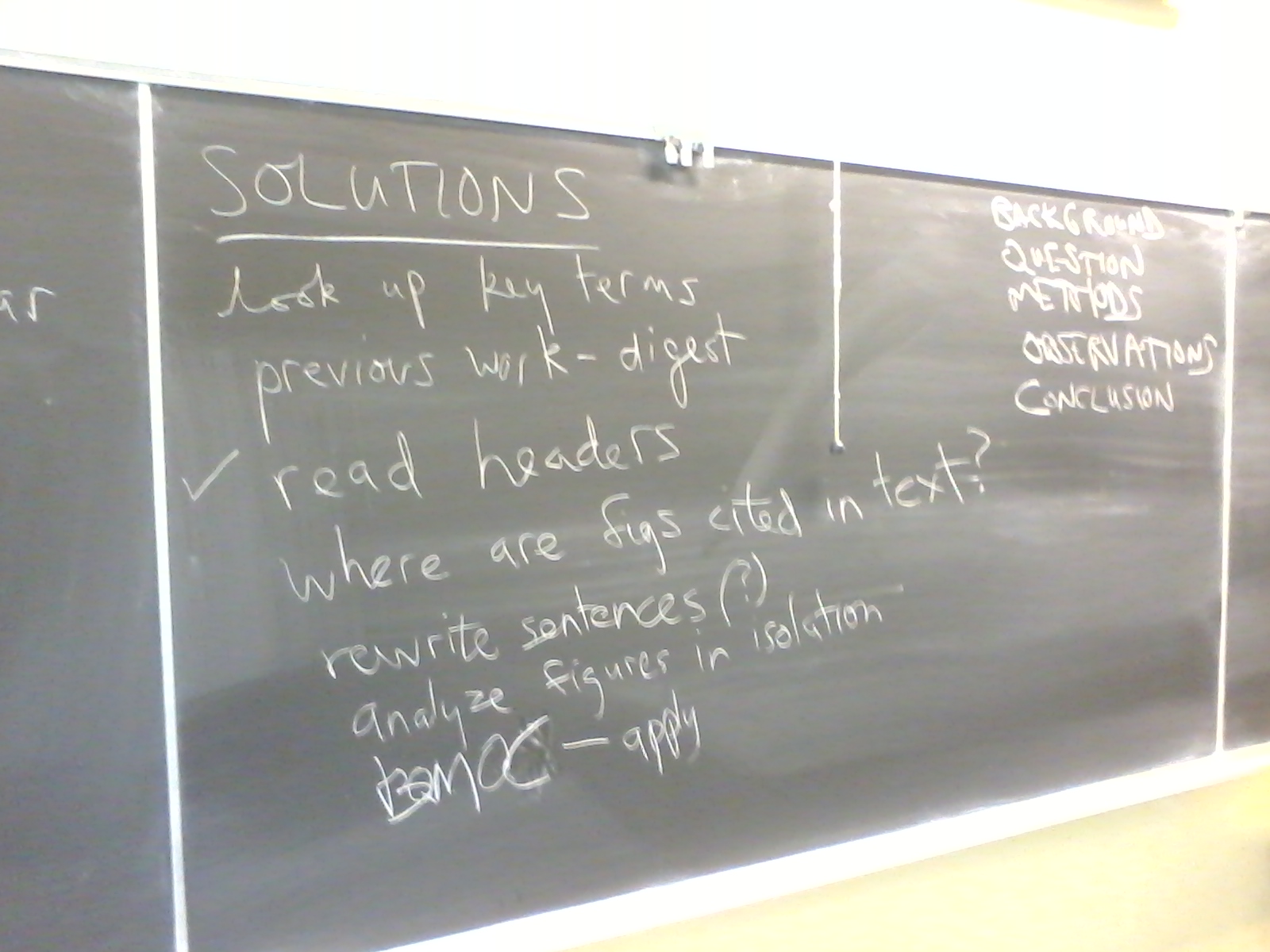
Yesterday, my Biology 485 students and I made a list of strategies for comprehending these difficult but valuable papers. Here are some of my favorites.
• If the Introduction section of a paper doesn’t make sense, the rest of it probably won’t make sense either. Consult key references to help you digest the Introduction.
• Figure out which new vocabulary terms are absolutely central to the paper, and learn those.
• As a first pass through the article, just read the headers of the sections and subsections to get an overview. As a second pass, read the article QUICKLY, not getting bogged down in details. Then go back and read the article again.
• To understand the main point of a given figure or table, find where and how it is cited in the main text.
• As a test of whether you understand a given sentence or paragraph, rewrite it in your own words.
• Apply BQMOC analysis (Background, Question, Methods, Observations, Conclusions) to individual parts of the paper — individual figures, for example.
• Finally — and perhaps most importantly — read each paper for a specific purpose. There’s so much crammed into each one that filtering the information can be a formidable challenge. Read the paper with specific questions in mind (either provided by the instructor, or self-generated), and focus your attention on the parts that directly address those questions.


 My Track Record
Leave a reply to Shelby Cancel reply