Last night I received the news that my Ph.D. adviser had just died of cancer.
For me, this was one of those moments of asking myself, “Did I ever thank this person adequately for what they did for me?”
Kevin and I had a complicated relationship. As a scientist and as a mentor, he had his share of blind spots, and as a graduate student, I had numerous deficiencies of my own. What is indisputable is that he took his advising role very seriously, and gave it his full attention, and did everything he could to help me along my path, which he accepted as different from his own. He treated me, above all else, with kindness and generosity.
Technically, I had two graduate advisers: Kevin and Marty Kushmerick. Kevin did almost all of the actual advising, but he knew that it was useful for me to be associated with Marty, a more senior and more famous scientist. Thus, at conferences and such, I would always say, “I work with Kevin and Marty.” Kevin never objected to this, though he surely deserved more credit than that.
In the winter and spring of 2000, my work was not going well, and Kevin and I were finding it hard to have productive discussions. I suggested that I spend the summer at a high-altitude training study that had accepted me as a research subject. A greedier adviser would have stopped me from going — shouldn’t I be in the lab, generating more data for him? But Kevin, to his great credit, let me go. I had an experience that was useful scientifically (I got to see first-hand how complex human studies are conducted), and that also helped reset our relationship. When I returned, we were able to communicate with less frustration.
A final act of selflessness on Kevin’s part came when I was wrapping up my dissertation. There was one chapter that he found unconvincing (for reasons that I never really understood). He was not willing to have the paper published with his name on it; however, he did let me publish it. If this seems like a no-brainer, it wasn’t; research leaders are often VERY conservative and controlling about the papers that come out of their labs.
The above examples stick out in my mind, yet they fail to capture what might have been most important of all, which was simply that Kevin allowed me to barge into his office and ask for help whenever I wanted. This wasn’t necessarily an efficient arrangement for getting work done or helping me become more resourceful and independent, but it certainly indicated the extent of Kevin’s commitment to me.
Years after I left the lab, I wrote an odd little parody of the classic Bob Dylan song Knockin’ On Heaven’s Door. The lyrics were, most directly, about the frustrations of doing research. But the subtext of “Knockin’ On Kevin’s Door” was that, as an often-rudderless graduate student, I was very fortunate to have an adviser who was always, always, always willing to make time for me.
I should have told him this more directly, with more explicit gratitude.
I hope he got the message anyway.
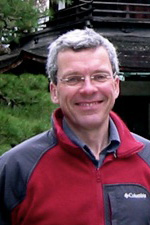
[image from UW Dept. of Radiology website]


 My Track Record
Leave a reply to …And my other Ph.D. adviser, Martin J. Kushmerick | My Track Record Cancel reply